Quintel Blogger theme

A free Premium Blogger theme.

Showing posts with label Science. Show all posts

Sunday, March 17, 2013

10+1 PSEB Chemistry Sample Paper


Subject – Chemistry
  1.  Define Isotopes & Isobars with examples.
  2.  Define Enthalpy and Avogadro law.
  3.  Write general configuration of P block elements.
  4.  Define Reduction .
  5.  Define global warming & one factor responsible for it.


6.   Explain why cations are smaller and anions are larger  in radii than their parent atom?
  7.  What are major differences between metals and non metals? Give an example of  liquid metal at room temperature.
  8.  Describe the property of catenation with example of carbon.
  9.  Calculate the oxidation number of S in H2SO4& N in HNO3.
10.  Draw molecular orbital diagram of H2, H2+ & He2.
11.  Define Hyper conjugation effect with example.
12.  Calculate number σf & π bonds in the following structure/ following  molecule.
            CH2=    CH2       CH2Cl2
13.  Balance the following redox reaction by Ion electron method
       Cr2O2- 7 (aq)+ SO2(g)→ Cr3+ (aq)+ SO42-(aq) in acidic solution.
14.  Define oxidation. Calculate the oxidation number of:
       1. S in H2S             2. C in CO2                               3. Pb in Pb3O4
15. Describe usefulness of Bohar's model. Calculate the mass of a photon with wavelength 3.6 A°.
16.  Define resonance with examples. Draw resonance structure of Benzene & Ozone.
17.  Define covalent bond. Draw structure of CH4 & H2O.
18.  Write a short note on hydrogen bonding.
19.  Write about unique position of hydrogen in periodic table.
20.  Write a brief note on carbocation & carbanion with example.
21.  Select Electrophiles & nucleophiles out  of H+, Na+, NH3, OH-, C2H5OH, C1-.
22.  Write definitions of 3 gaseous laws.A vessel of 120ml capacity contains a certain mass of a gas at 20° c and 750mm pressure. The gas was transferred to a vessel is 18

Sunday, February 10, 2013

CBSE SCIENCE SAMPLE PAPER


Q.1. A Person is advised to wear spectacles with concave lens. What  type of defect of vision is he suffering from?

Q.2.What is the structural formula for ethanol?

Q.3.If all the waste we generate is biodegradable; will this have no impact on the environment?


Q.4. Rearrange the following according to their ascending trophic levels in a food chain: Eagle, Plants, insects, Frog

Q.5.Is the position of a star as seen by us is true position. Justify your answer.

Q.6.A mirror form 2 times real & inverted image when object is placed at a distance of 10cm. At what distance should an object be placed so that image is 3 times virtual & erect?

Q.7.Give reason:

(i)Danger signals are made of red colour.

(ii)The sky appears to be blue during day time to a person on earth.


Q.8.An element X is in second period & group 16 of the periodic table:

(i)Is it metal or non-metal?

(ii)What is its valency?

(iii)What will be the formula of compound of X with Na?


Q.9.How does electronegativity of an element vary on moving from:

(i) Left to right in a period.

(ii)Bottom to top in a group.


Q.10.(a)What is isomerism?

           (b)Draw the electron dot structure of CO2.


Q.11.What is meant by management & conservation of natural resources? Why must we conserve our forests?


Q.12.(a)What is the signification of sexual mode of reproduction?

           (b)What is the site of fertilization in human beings?


Q.13.(a)Why is cross-pollination considered to be superior than self-pollination?

           (b)State the method used for growing rose plants.


Q.14.(a)Convex mirror & a plane mirror forms virtual image. How will you distinguish between the two by looking at the images of an object?

          (b)When we focus sunlight using a convex lens at the tip of a matchstick, what will happen? Why?

Q.15.(a)State the reason for the following observation recorded from the surface of the moon:

            (i)Sky appears dark.

            (ii)Rainbow is never formed.

            (iii)Why does a diamond sparkle?


Q.16.(a)when white light hits a prism surface, why does it split into constituent colour?

           (b)The sun appears oval during evening hours. Why?


Q.17.(a)What is hydrogenation? Write one of its industrial application.

           (b)Why acetic acid is known as glacial acetic acid?


Q.18.(a)Write the names and structure of the compounds  HCOOH and  HCHO.

              (b)A mixture of oxygen &  ethyne is burnt for welding. Why do you think a mixture of ethyne & air is not used?


Q.19.Define variation in relation to a species. Why is variation beneficial to the species?


Q.20. Explain the importance of fossils in deciding evolutionary relationships.


Q.21. Distinguish between acquired & inherited traits by giving one example of each. Why are traits acquired during the lifetime of an individual not herited?


Q.22. Reproduction is essentially a phenomenon that is not for survival of an individual but for the stability of a species. Justify.


Q.23.(a)Is it possible to form a real image using a real object with a concave lens?

            (b)What is the emergent angle of light after refraction in a glass slab?

            (c)Define angle of prism.

OR

     (a)A person wants to see the full length image of tall building in a small mirror. what type of mirror is used by him?

    (b)Name a mirror that can give an erect & enlarged image of an object.

    (c)Magnification produced by a concave mirror of a body 4cm in size is 0.16. what is the size of the image?


Q.24. (a)Draw a labeled diagram to show the refraction through a triangular glass prism.

            (b) Define the angle of deviation

            (c) Write the factors on which angle of deviation depends

Or

(a) What is a homologous series of substances?

(b) In an organic compound, which parts largely determine its physical and chemical properties?

(c)Write a chemical equation to represent the reaction of ethanol with acidified solution of potassium dichromate.


Q.25.(a)How does the embryo get nourishment inside the  mother’s  body?

           (b)What are the functions of testes in human males?

           (c)Why does menstruation occur?

OR

(a)What are the different methods of contraception?

(b)Where are the vegetative buds present in Bryophyllum?

(c)Where does the formation of DNA copy occurs?

Q.26. The angle of incidence  i and reflection  r are equal during the refraction through a transparent slab ,the value of  i  is,

(a)0 °                    (b)45°                    ( c)90 °                     (d)depend on the material of the slab


Q.27. The self linkage property is maximum in.

(a) carbon         (b) silicon               (c) sulphur                (d) phosphorus


Q.28. As incident angle is decreased for the given pare of medium, the angle of refraction will ,

(a) increase      (b) decrease        (c) may increase or decrease     (d) always remains same


Q.29.The magnification of plane mirror is

(a) -1                 (b) +1                         (c) 0                                                    (d) Infinitive


Q.30. Which part of the bryophyllum plant help in vegetative propagation

(a) roots           (b) stem                    (c) leaves                                          (d) flowers  


Q.31. For a given medium the R.I is maximum for the color

(a) Red             (b)Blue                     (c)Violet                                        (d)Green.


Q.3. The boiling temperature of ethenoic acid is .

(a) 285 K          (b) 391K                    (c) 373K                                         (d) 413K

Q.33. The colour of copper sulphate solution is,

(a) colourless                          (b) yellow                    (c) orange                      (d) blue


Q.34. To prevent the misuse of alcohol which poisonous substance is added in it?

(a. Methanol                            (b.) Ethanol                (c.) Butanol                   (d.) Ether


Q.35. Which Substance is used as pickles preservative?

(a) Ether                                 (b) Acetic acid            (c) Vinegar                    (d) Ethanoic acid


Q.36. In modern periodic table how many columns are vertically arranged?

(a) 16                                      (b) 18                            (c) 14                               (d) 20


 Q.37. In an experiment to determine the focal length of a convex lens, a student obtained a sharp inverted image of distant tree on the screen behind the lens. He / She then removed the screen and looked through the lens in the direction of object. She / He will see. -

(a.) An inverted image of tree at focus of lens.     

(b.) No Image as the screen has been removed

(c.) A blurred image on the wall of laboratory

(d.) An erect image of the tree on the tree on the lens


Q.38. For doing experiment on verifying the Causes of reflection of light. A student sets up his apparatus as shown. The experiment is more likely is get preformed successfully if the screen shown is a.

(a) Well polished plane mirror

(b) Wooden board with many holes in it

(c) A foam padded board

(d) A sheet of pure white cloth


Q.39. The focal length of a concave mirror depends on it.

(a) Size                     (b) Radius of curvature           (c) Pole                  (d) Center of curvature


Q.40. The diameter of the reflecting surface of spherical mirror is called.

(a) Focal length     (b) Radius of curvature           (c) Aperture         (d) Principal focus

Thursday, January 17, 2013

Pollution - causes and remedies


Pollution developed into an acute problem everywhere in cities and industrial towns. Presence of smoke and gaseous byproducts of industries in the atmosphere is detrimental to health. Improper disposal of sewage water also causes pollution. The majority form of pollution that is affecting the human kind very badly is air pollution. Poor environment is directly responsible for around 25 per cent of all preventable ill health in the world today, and two-thirds of those affected are children.


We cause air pollution directly

  • through our use of electricity, fuels, and ransportation. 
    Most of this air pollution we cause results from the burning of fossil fuels, such as coal, oil, natural gas, and gasoline to produce electricity and power our vehicles.
  • Road dust, windblown dust, agriculture and construction, fireplaces
  • Fuel combustion in motor vehicles, equipment, and industrial sources; residential and agricultural burning. 
  • Coal or oil burning power plants and industries, refineries, diesel engines
    People pollute the water with chemicals and other hazardous materials.
  • Tobacco smoke , Fire Crackers


Effects and Remedies

  • Cancer, burning sensation in the eyes or nose, throat irritation, bronchitis, severe asthma, and a decrease in lung function. make us confused and sleepy.
  • Stay indoors during days when pollution levels are high. Many pollutants will be at lower levels indoors than outdoors.
  • If you have to go outside, limit outside activity to the early morning hours or wait until after sunset. This is important in high ozone conditions because sunshine increases ozone levels.
  • Don’t exercise or exert yourself outdoors when air-quality reports indicate unhealthy conditions. The faster you breathe, the more pollution you take into your lungs.

·         Look into installing energy saving lights 
Ride a bike, carpool, walk, or take mass transportation to work
Use reusable lunch containers 
Use reusable cups for coffee and other beverages
 Limit fertilizers and pesticides, especially near lakes and streams

  • Recycle plastics, glass, newspaper, used motor oil, transmission fluid and brake fluid
  • Reuse grocery bags by taking them with you to the store
    Pack children’s lunches in reusable containers instead of disposal brown and plastic bags
    Start an Eco-Club or form a pollution prevention team

Wednesday, December 19, 2012

CHOOSING LENSES

CHOOSING LENSES

TYPES OF LENSES
Review the various lens designs and choose what fits your lifestyle.
Single VisionSingle vision lenses function as all purpose glasses for persons who have normal accommodations. Persons who normally wear bifocals or trifocals can use single vision for distance or near (reading) lenses. Single vision lenses can also function as occupational glasses for certain types of work. Single vision lenses are available in all lens materials.
Bifocals (Flat Top)A flat top bifocal is a correction for distance and near vision in one pair of glasses. Flat Top 28 is the most popular bifocal form. It is also available with the bifocal portion made in a variety of widths (Flat top 35 and Executive Bifocals) to help with various close-up occupations. Flat tops are made in all lens material types.
Executive Style BifocalsSometimes used for those who need a wide field of vision for near work (accountants, for example), Executive Style Bifocals have a distinctive appearance and are thicker because of their design. They are generally only available in hard resin and polycarbonate.
TrifocalsTrifocals come in a variety of designs. Flat top trifocals are the most widely used form. The added segment provides clear vision at arm's length distance, the area that is usually blurred for bifocal wearers. Trifocals are available in all lens materials.
Progressives (no line bifocals)These lenses provide all the benefits of bifocals but add the feature of continuous clear vision at all distances, including mid-range distance (arm's length). Progressives have the cosmetic advantage to be single vision lenses so they never reveal the user wears bifocals. Progressives are available in all lens materials and also made in aspheric form. Because of their many benefits, they are becoming the lens of choice for bifocal and trifocal wearers.
Aspheric LensesThese new lenses provide special visual and cosmetic benefits for stronger corrections and increase edge to edge clarity. Flatter than conventional lenses, aspheric's eliminate the "bulgy" appearance of strong plus lenses (far-sighted corrections) and greatly enhance the appearance of finished eyewear. Persons with strong nearsighted corrections also benefit from thinner, lighter weight glasses when their lenses are aspheric. Because aspheric lenses are positioned closer to the face, there is less eye magnification with farsighted corrections and less "small eyes" look with nearsighted corrections. Aspheric lenses are often made of high index materials for the ultimate in thin lenses.
Sports GlassesAll sorts of special lens designs are available for the special needs of sports enthusiasts. Poly carbonate is usually the material of choice for active sports.
Computer GlassesThere are a variety of options for those who use computers. These include special filters and anti-reflection coatings.
Polarized Sun LensesThese are the exciting sunglasses that eliminate reflected glare. They are especially appropriate for drivers, fisherman, hunters and all types of outdoor activities.

LENS MATERIALS
Your first decision involves the material in which you want your new lenses made. When appearance and comfort are important, you may want lenses made in poly carbonate or high index. If active sports or work play a role in your lifestyle, you'll want to order poly carbonate Or, you may want lenses that automatically darken in sunlight. The following information will help you make your choice.
CR39 - PlasticConventional hard resin lenses are half the weight of glass lenses and can be tinted to almost any color and density. Hard resin lenses are more easily scratched than glass but can have an optional scratch protection applied. More impact resistant than glass, hard resin lenses do not require heat treating.
High Index Modern technology has created lenses that bend light differently so that stronger corrections are thinner than when made in conventional materials. Such lenses are called "high index" and stronger corrections are more attractive because they are slimmer. Glass lenses are also available with the slimming advantages of High index but are considerably heavier. High index plastic uses less material so they are often lighter in weight. High index lenses absorb all harmful UV light and can be tinted to any shade or color.
TransitionsThese are lenses that darken as you go from indoors to outdoors. They are available in both glass and lightweight hard resin. They darken to a moderate shade of grey or brown.
Polycarbonate
Poly carbonate lenses are the most impact resistant lenses available and are always the lens of choice for young people and active patients. Poly carbonate lenses are high index and are usually the lightest, most comfortable lenses. They absorb all harmful UV light and can be made with ultra thin edges because of their unique strength.
Varilux™Varilux lenses enable your eyes to make a smooth, gradual transition when you change your focus from near to intermediate to far vision. Unlike bifocal lenses, Varilux lenses eliminate the line that creates an abrupt, annoying vision change from near to far vision. The added comfort of Varilux is achieved with an increased field of vision. This larger vision field reduces unnecessary head movements both vertically and horizontally, which means you can assume a more natural, comfortable posture when viewing objects at close and intermediate ranges.
GlassFor years glass was the only lens material available and glass still offers superior optics. The most scratch-resistant material, the primary disadvantage of glass is its weight, generally twice that of hard resin. Glass lenses are heat or chemically treated to increase impact resistance.

LENS COATINGS & TREATMENT
TintAll lens materials except glass can be tinted in any color desired. Shades of any color ranges from 1 to 4 with 3 (ie. a grey #3) being the most common sunglass shade ordered. Solid and gradient tints are available.
UV ProtectionIt is generally accepted that the ultraviolet rays in sunlight pose potential harm to eyes. Specific treatment is available for plastic lenses that completely blocks hazardous UV light. Lenses like poly carbonate and high index include built-in UV protection at no extra cost.
Anti-Reflective CoatingSpecial anti-reflective coatings are now available for spectacle lenses, much like those used for fine camera lenses. These coatings are particularly effective for reducing eye fatigue for computer operators and anyone driving at night. And, of course, AR lenses enhance appearance by removing all distracting reflections.
Scratch ProtectionLight weight plastic lenses can be more easily scratched than glass. Eye Deal Eyewear offers a one time replacement warranty against scratches during the first year.

HOW SHOULD I LOOK AFTER MY EYEGLASSES?
• DO NOT place them face down.
• DO NOT put them on and take them off with one hand as this can stretch the joints.
• DO NOT clean plastic lenses with tissues.
• DO keep them in a case when not worn.
• DO clean them with a soft cloth and suitable cleaning fluid or a drop of warm water and detergent.
• DO come back and have your frame adjusted if required - There is no charge for this.
• DO remember that if you are dependant on your eyeglasses for driving or for your work you should
consider a spare pair in case of loss or breakage. Many people don't think about this until it is too late.


STANDARD
LENS POWERS RANGE Sphere Powers: +/-6.00 diopters in .25 increments Cylinder Powers: -3.00 diopter in .25 increments Bifocal Style: Flat top-28mm segments with adds up to +3.00

Eyeglass prescription

Eyeglass prescription

An eyeglass prescription is an order written by an eyewear prescriber, such as an optometrist or ophthalmologist, that specifies the value of all parameters the prescriber has deemed necessary to construct and/or dispense corrective lenses appropriate for a patient.
If an examination indicates that corrective lenses are appropriate, the prescriber generally provides the patient with an eyewear prescription at the conclusion of the exam. The parameters specified on spectacle prescriptions vary, but typically include the power to which each lens should be made in order to correct blurred vision due to refractive errors, including myopia, hyperopia, astigmatism, and presbyopia. It is typically determined using a phoropter asking the patient which lens is best, computer automated refractor, and through the technique of retinoscopy.
Similar to medical prescriptions, eyeglass prescriptions are written on paper pads that frequently contain a number of different abbreviations and terms:
  • DV is an abbreviation for distance vision. This specifies the part of the prescription designed primarily to improve far vision. In a bifocal lens, this generally indicates what is to be placed in the top segment.
  • NV is an abbreviation for near vision. This may represent a single-vision lens prescription to improve near work, or the reading portion of a bifocal lens. Some prescription forms use ADD in place of NV with a single box to indicate the additional refractive power to be added to the spherical of each eye.
  • OD is an abbreviation for oculus dexter, Latin for right eye. Oculus means eye. In some countries, such as the United Kingdom RE (right eye), LE (left eye), and BE (both eyes) are used. Sometimes, just right and left are used.
  • OS is an abbreviation for oculus sinister, Latin for left eye.
  • OU is an abbreviation for oculi uterque, Latin for both eyes.
  • A spherical correction corrects refractive error of the eye with a single convergent or divergent refractive power in all meridians.
  • A cylindrical correction corrects astigmatic refractive error of the eye by adding or subtracting power cylindrically in a meridian specified by the prescribed axis.
  • The axis indicates the angle in degrees of one of two major meridians the prescribed cylindrical power is in.
Most eyeglass prescriptions will contain values here. The spherical and cylindrical columns contain lens powers in diopters (see below).
  • Prism and Base are usually left empty, as they are not seen in most prescriptions. Prism refers to a displacement of the image through the lens, and is used to treat eye muscle imbalances or other conditions (see vergence dysfunction) that cause errors in eye orientation or fixation. Prism correction is measured in "prism diopters", and Base refers to the direction of displacement.
  • Pupillary Distance (PD) is the distance between pupils, usually given in millimeters.
  • Back vertex distance (BVD ) is the distance between the back of the spectacle lens and the front of the cornea (the front surface of the eye). This is essential in higher prescriptions (usually above ±4.00D) as slight changes in the distance between the spectacles and the eyes above this level can cause the patient to perceive a different power, leading to blur and/or other symptoms.

Background

Blur is the subjective experience or perception of a defocus aberration within the eye. Blur may appear differently depending on the amount and type of refractive error. The following are some examples of blurred images that may result from refractive errors:
Blur is corrected by focusing light on the retina. This may be done with eyeglasses or contact lenses, or by altering the shape of various eye structures via refractive surgery or special contact lenses.
The eye chart is the background used by eye doctors to compare the patient's visual acuity with the one of other human beings. Although there are many variations of the eye chart, the standard one is the Snellen eye chart, which was developed by Dutch eye doctor Hermann Snellen in the 1860s. .
Individuals who are not able to read letters for various reasons including being too young to know the alphabet or having a handicap, eye doctors may use what is called the tumbling E chart. This type of chart is a variation of the Snellen chart and it shows the capital letter E, at different sizes and rotated in increments of 90 degrees. The scale of the tumbling E chart is the same as with the standard Snellen chart. The eye doctor, in this case, will ask the person being tested to use either hand (with their fingers extended) to show which direction the "fingers" of the E are pointing: right, left, up or down.[3]
In the United States, a 20/20 visual acuity is considered normal. This means that the chart is normally placed at 20 feet distance from the person who is being tested. 20/20 visual acuity is considered normal vision for individuals but not perfect as some individuals, although rarely, can see at 20 feet what others can see at 10. The poorest visual acuity is 20/200 and a person with the best-corrected vision, or vision once wearing corrected lenses, of 20/200 is normally considered legally blind. Individuals with 20/200 vision are normally able to read only the first letter on the chart. Usually the 20/20 line of letters is fourth from the bottom, with 20/15, 20/10 and 20/5 below that. Not many people have 20/10 or better visual acuity, but many animals do, especially birds of prey, which have been estimated to have an acuity of 20/5 or even better. In the United States individuals who want to get their driver license without a corrective lenses restriction must have at least 20/40 visual acuity.

Lens power

The values indicated in the sphere and cylinder columns of an eyeglass prescription specify the optical power of the lenses in diopters, abbreviated D. The higher the number of diopters, the more the lens refracts or bends light. A diopter is the reciprocal of the focal length in meters. If a lens has a focal length of 13 meters, it is a 3 diopter lens.
A +10 diopter lens, which has a focal length of 10 centimeters, would make a good magnifying glass. Eyeglass lenses are usually much weaker, because eyeglasses do not work by magnifying; they work by correcting focus. A typical human eye without refractive error has a refractive power of approximately 60 diopters.
Stacking lenses combines their power by simple addition of diopter strength. A +1 diopter lens combined with a +2 diopter lens forms a +3 diopter system.
Lenses come in positive (plus) and negative (minus) powers. Given that a positive power lens will magnify an object and a negative power lens will minify it, it is often possible to tell whether a lens is positive or negative by looking through it.
Positive lenses cause light rays to converge and negative lenses cause light rays to diverge. A negative lens combined with a positive lens results in a system with a power equal to the sum of the two lenses, so a −2 lens combined with a +5 lens forms a +3 diopter system.
A −3 lens stacked on top of a +3 lens looks almost like flat glass, because the combined power is 0.
In science textbooks, positive lenses are usually diagrammed as convex on both sides; negative lenses are usually diagrammed as concave on both sides. In a real optical system, the best optical quality is usually achieved where most rays of light are roughly normal (i.e., at a right angle) to the lens surface. In the case of an eyeglass lens, this means that the lens should be roughly shaped like a cup with the hollow side toward the eye, so most eyeglass lenses are menisci in shape.
The most important characteristic of a lens is its principal focal length, or its inverse which is called the lens strength or lens power. The distance from the lens to that point is the principal focal length of the lens. For a double concave lens where the rays are diverged, the principal focal length is the distance at which the back-projected rays would come together and it is given a negative sign

Amount of refractive error and degree of blur


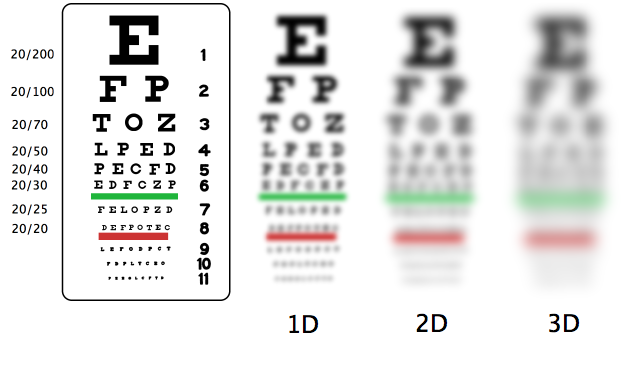
Approximation of blur seen by a patient.
The leftmost image above shows a Snellen eye chart as it might be seen by a person who needs no correction, or by a person who is wearing eyeglasses or contacts that properly correct any refractive errors he or she has.
The images labelled 1D, 2D, and 3D give a very rough impression of the degree of blur that might be seen by someone who has one, two, or three diopters of refractive error. For example, a nearsighted person who needs a −2.0 diopter corrective lens will see something like the 2D image when viewing a standard eye chart at the standard 20-foot distance without glasses.

Distant vision and near vision

The DV portion of the prescription describes the corrections for distant vision. For most people under forty years of age, this is the only part of the prescription that is filled in. The NV or near-vision portion of the prescription is blank because a separate correction for near vision is not needed.
The NV portion is used in prescriptions for bifocals.
In younger people, the lens of the eye is still flexible enough to accommodate over a wide range of distances. With age, the lens hardens and becomes less and less able to accommodate.
Because young children have a wider range of accommodation than adults, they sometimes examine objects by holding them much closer to the eye than an adult would.
Buying Glasses
The actual purchase process for glasses, for most people, involves visiting an eyeglass store, getting a “free” test from an optometrist, and then buying their expensive glasses.
Maintaining Glasses
Maintaining glasses isn’t too hard, either. Just remember that you don’t need to replace the frames and lenses every and that with a bit of effort, frames can last for many years and lenses can last for several years, too, if you don’t face a prescription change. Here are some tips for maintenance.
Wash them regularly I wash mine every other day or so in warm, soapy water, then dry them with a soft cloth. This keeps the lenses quite clean and thus reduces the chances for scratching. Don’t use anything scratchy to dry the lenses – avoid paper towel drying like the plague.
If they get scratched… Try polishing the scratch with some eyeglass polish. You can usually find a can of this for $8 to $10 at the eyeglass store – ask for help before buying because some brands don’t work well on glasses with various coatings on the lens. This is far, far cheaper than replacing your lens, because a can of polish should be able to last for years.
You can try baby oil as well – this often removes small scratches on lenses. Just buff it off with a very soft cloth. I have heard of other solutions, but they all work only on specific lens types.
If the frame gets broken… Superglue is often your best friend for longer pieces that are broken in the middle.
If a screw gets loose… Screw it back into place, then apply a drop of nail polish to the top of the screw. That’ll hold it right where it should be.

Features

Bifocals or trifocals are more costly than standard lenses, and no-line bifocals are priced even higher. Having extras such as scratch-resistant coating or anti-glare coating will edge up the price as well.
price of eyeglasses is still highly connected with other features, including varied coatings. Shatter-resistant coating, anti-reflective coating and others frequently charge customers significantly additional charges. In a few cases, the price of a special pair of glasses equipped with some extra features can be several times higher than a normal pair. There's a much bigger opening among differing types of fashion frames.
Along with the types of lenses and frames chosen, choosing where to purchase eyeglasses is a big factor in cost. Generally, warehouse clubs and internet retailers have lower prices than optometrists' offices or chain stores. However, for quality follow-up service you might consider paying a little more if you can afford to.